Donut Stress Just Do Your Best SVG
A Sweet Little Reminder—But Will It Stitch Cleanly?
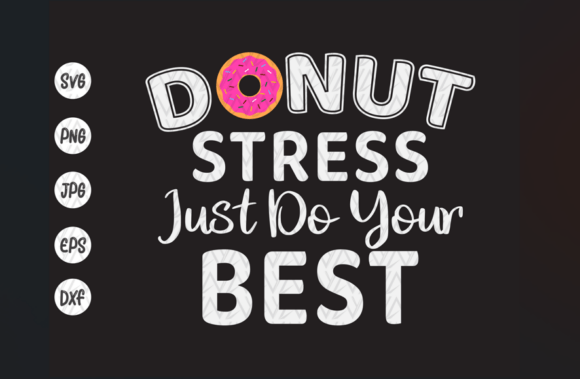
As someone who’s stitched hundreds of designs onto everything from baby onesies to boutique aprons, my first impression of Donut Stress Just Do Your Best SVG was warm and familiar—like spotting a well-loved phrase on a coffee mug. The donut shape is playful but not childish; the text “Just Do Your Best” feels grounded, gentle, and quietly affirming. It’s not sarcastic or ironic—it leans into kindness without being cloying. That matters when you’re embroidering something meant to comfort: a nurse’s tote bag before a long shift, a teacher’s sweater for back-to-school week, or a new parent’s kitchen towel. This isn’t just decoration—it’s emotional punctuation.
Where This Design Shines in Real Embroidery Projects
I tested Donut Stress Just Do Your Best SVG as a machine embroidery design on a medium-weight cotton twill tote bag—and it landed beautifully. The rounded donut outline gave me clean satin stitch edges, and the short phrase sat comfortably inside with room to breathe. No crowding, no awkward kerning. Because the letterforms are open and slightly rounded (not thin or overly stylized), they translated well into fill stitch without ghosting or thread pooling. I used three thread colors—soft pink for the donut, warm gray for the text, and a pale cream background fill—and the contrast held up even at 8 inches wide.
It also worked surprisingly well on a lightweight unlined sweatshirt. The design didn’t overwhelm the fabric, and because the layout avoids fine interior details (no sprinkles, no tiny icing swirls), there was no risk of dense stitch areas buckling or puckering. That makes it ideal for beginner-friendly projects like embroidered pillow covers, tea towels, or baby bibs—where simplicity supports durability and washability.
For Etsy sellers and small shop owners, this is low-risk, high-appeal design territory. It fits naturally into collections around self-care, teacher appreciation, mental wellness, or cozy home goods. Pair it with neutral tones and natural fibers, and it reads as intentional—not trendy, not dated.
Where to Use It Thoughtfully
That said, Donut Stress Just Do Your Best SVG isn’t universally foolproof. On highly textured fabrics like heavy terry cloth or bouclé knit, the clean lines can blur. On stretchy fabric—say, a ribbed cotton tee—you’ll need cutaway stabilizer underneath and possibly reduced stitch density to prevent distortion. And while the design scales nicely up to 10 inches, shrinking it below 3.5 inches starts to compromise legibility, especially in the lowercase “o” and “e” in “Best.” Tiny lettering like that doesn’t hold up in satin or fill stitch without careful digitizing—something this Graphics file doesn’t guarantee unless confirmed by the seller.
Curved surfaces—like the front of a structured cap—require extra attention. The circular shape helps, but if your hoop size is tight or your cap has deep seams, test placement first. Also, avoid layering this over seams or zippers unless you’ve pre-tested tension and fabric give. And on dark fabric? Check how the white or light-colored elements read in your final thread palette—some PNG mockups lie. Always run a black-and-white print test to see value contrast before stitching.
What It Adds (and Doesn’t Add) to Your Finished Product
This isn’t a flashy, attention-grabbing embroidery file—it’s a quiet connector. When stitched well, Donut Stress Just Do Your Best SVG elevates handmade product perception by signaling care in both message and execution. Customers notice that. A personalized gift with this design feels considered, not generic. A boutique’s curated line of embroidered kitchen linens gains warmth and approachability. Even commercial embroidery clients—like a local yoga studio ordering staff totes—respond to its grounded tone.
But it won’t carry weak execution. If your stitch density is too high, the donut shape distorts. If you skip proper stabilizer on thin fabric, the text warps. If you ignore thread color contrast on a busy print, the message disappears. So while the design itself is strong, its impact depends entirely on how thoughtfully you treat it as an embroidery project—not just a digital download.
Practical Designer Notes Before You Stitch
- Always test on scrap fabric first—especially if using it for baby embroidery or items that will be washed frequently.
- Review stitch density in your embroidery software. Look for any areas where fill stitches overlap tightly—those spots may need manual adjustment for breathability.
- Confirm hoop size compatibility. While the SVG scales freely, your actual embroidery file may be built for a specific hoop—check before hooping delicate garments.
- Inspect small details like inner curves and letter counters. If your version includes very fine interior shapes, they may not digitize cleanly without expert editing.
- Test in both light and dark fabric mockups—don’t rely solely on the JPG preview.
- Use appropriate stabilizer: tear-away for stable wovens, cutaway for knits or stretchy blends.
- Verify licensing before selling finished items or bundling this as part of a craft business digital product. Since it’s listed as a digital download in the Crafts category, confirm whether commercial use is included.
Final Thought: A Design That Earns Its Place
Donut Stress Just Do Your Best SVG doesn’t shout. It settles in. That’s its strength—and its quiet demand: it asks you to match its intention with thoughtful execution. Whether you’re an Etsy seller building a brand around mindful making, a small shop owner curating holiday embroidery gifts, or a hobbyist stitching a meaningful present for a friend, this design works best when treated like a trusted collaborator—not just another graphics file. It’s simple enough to execute reliably, warm enough to resonate, and flexible enough to grow with your craft business. Just remember: good embroidery begins before the needle drops. Test, adjust, and trust your eye—and let Donut Stress Just Do Your Best SVG do the rest.